
Open a fresh habit tracker and the cursor blinks at you: add your first habit. It's a surprisingly hard prompt. Add too many and you'll abandon the whole system by February. Add vague ones ("be healthier") and there's nothing to actually check off.
So here's a working list. Not 200 filler ideas, just 40 habits that people genuinely sustain, organized by what they do for you, with a note on how to track each one, because the tracking mode matters more than people think. A checkbox is wrong for "drink more water" and a counter is wrong for "made the bed."
Before you pick: three rules
- Start with three habits, max five. Every habit you add taxes the ones you already have, which is why how many habits to track at once is the first thing to settle. You can always add more in March, and March-you will have earned the right.
- Make each one falsifiable. "Read more" can't be checked off. "Read 10 pages" can. If you can't say definitively whether you did it, the tracker can't help you.
- Match the mode to the habit. Checkbox for binary things, counter for repetitions, a number with units for quantities, a timer for duration. Forcing everything into checkboxes flattens your data and quietly teaches you to lie to yourself.
Health and body
- Drink 8 glasses of water — counter
- 8,000 steps — number, or let it sync from your phone's health data automatically
- Sleep by 23:00 — checkbox
- Stretch for 10 minutes — timer
- Gym, 3x per week — checkbox with a weekly goal, never a daily one
- Take vitamins or meds — checkbox
- No alcohol today — checkbox
- Eat one proper home-cooked meal — checkbox
- 7+ hours of sleep — number, synced from health data if possible
- No caffeine after 14:00 — checkbox
The water and steps habits are where checkbox-only trackers fall apart first. Five glasses out of eight is real progress; a checkbox renders it as failure. That's the kind of design detail covered in what makes a good habit tracker for developers, and it applies to everyone, not just developers.
Mind and focus
- Read 10 pages — number
- Meditate for 10 minutes — timer
- One deep-work block, 25 minutes minimum — timer, ideally with pomodoro built in
- Journal three sentences — checkbox
- Write 500 words — number
- Plan tomorrow before closing the laptop — checkbox
- Practice a language for 15 minutes — timer
- One hard problem before checking messages — checkbox
- Review the week, Sunday only — checkbox on a weekly schedule
- Learn one thing and write it down — checkbox
Number 14 deserves a comment: three sentences sounds almost insultingly small, and that's the point. Small minimums are what keep chains alive on terrible days. The full argument is in why streaks keep breaking.
One selection note before you go further down the list: a couple of these habits change other behaviour without you deciding to, and the rest don't. If you only want one, pick from that first group — keystone habits explains which ones actually carry others along and how to test whether yours does.
Digital hygiene
- Phone out of the bedroom — checkbox
- No social media before noon — checkbox
- Under 2 hours of screen entertainment — checkbox
- Inbox to zero, or at least to ten — checkbox
- No screens for the last 30 minutes of the day — checkbox
- One walk without the phone — checkbox
These are "absence habits," and they're harder to feel good about because nothing visible happens when you succeed. This is where a yearly heatmap earns its keep: forty green cells of "no doomscrolling before noon" is the visible thing.
Work and craft
- Ship one small thing — checkbox
- Review PRs before starting new code — checkbox
- Zero-notification first hour — checkbox
- Update the project log — checkbox
- Practice an instrument for 20 minutes — timer
- Sketch or draw, anything — checkbox
- Work on the side project, 25 minutes — timer
Home and people
- Make the bed — checkbox
- Ten-minute tidy — timer
- Cook instead of ordering — checkbox
- Call a parent or old friend, 2x per week — checkbox with a weekly goal
- One genuine compliment — checkbox
- Water the plants, Mondays — checkbox on a specific-day schedule
- Plan one thing to look forward to — checkbox
Habits that aren't worth tracking
A few popular ones quietly don't work as tracked habits. "Be more present" and "stress less" aren't actions, so there's nothing to log. Outcomes like "lose weight" don't belong either: you can't do a kilogram. Track the inputs (steps, cooking, sleep) and let outcomes follow. And anything you already do automatically, like brushing your teeth, just adds logging noise. Tracking is for habits still under construction. If nothing comes to mind, generate a few habit ideas and take the two that make you wince slightly — those are usually the right ones.
How to actually start
Pick three from this list. One health, one mind, one that's purely easy, because the easy one carries your momentum on the days the other two wobble. Give them two weeks before adding a fourth. And if none of these 40 quite fit your life, there's a wider menu of habit tracker ideas organized by life area and tracking format.
Then put the checkboxes somewhere you can't avoid them. A home screen widget turns logging into a one-second tap, and with schedules and weekly goals set honestly (rule 5 and 37 above), the tracker describes your real plan instead of an imaginary perfect one. That's the whole trick. The list matters less than the fit.
FAQ
How many habits should I track at once?
Three to five. Research on behavior change consistently favors focusing on few changes at a time, and in practice every additional habit raises the odds of abandoning the whole tracker. Start small and expand once the first set runs on autopilot.
Should I track habits daily or weekly?
Match the tracker to reality. Genuinely daily habits (sleep, water, reading) get daily schedules. Things like gym sessions or calling family work better as weekly goals, "3x per week," so rest days don't register as failures.
What's the best habit tracking method?
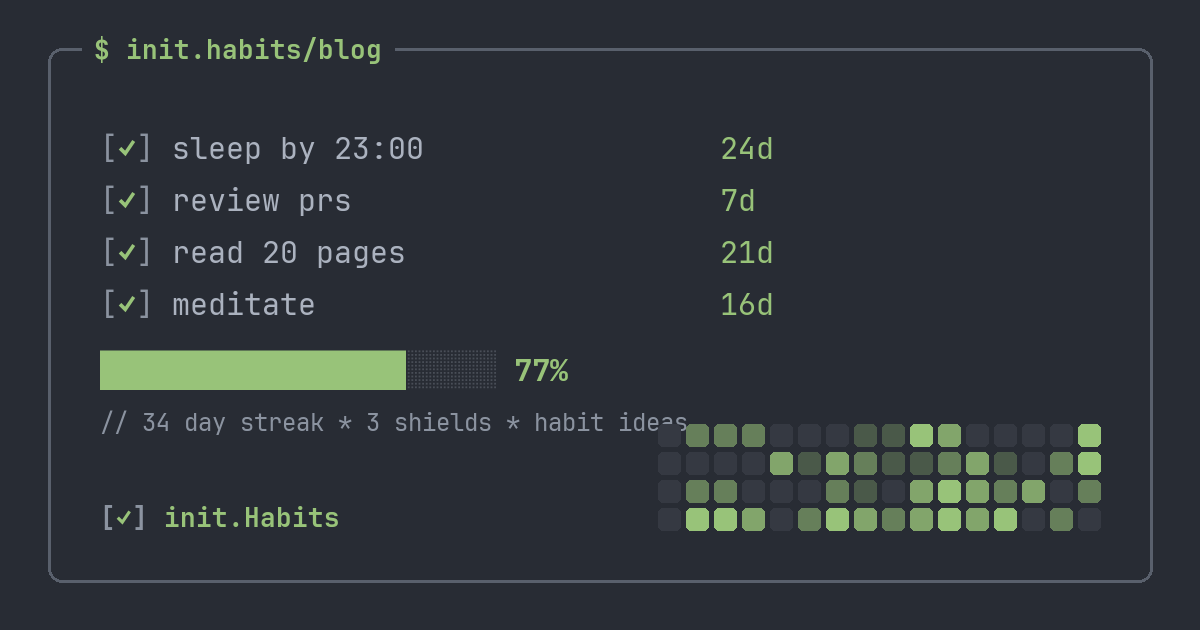
The one that makes logging nearly free. For most people that's an app with widgets — init.Habits, for instance — so completing a habit costs one tap from the home screen, with a heatmap view that keeps progress visible over months. Paper works too, until travel or a busy week breaks the ritual.
What habits do people stick with longest?
Small, concrete, hard-to-fail ones: making the bed, taking vitamins, reading a few pages. Ambitious habits survive when they have a tiny minimum version. The pattern across all of them is the same: low friction, clear definition of done, and a tracking system that tolerates the occasional miss.