
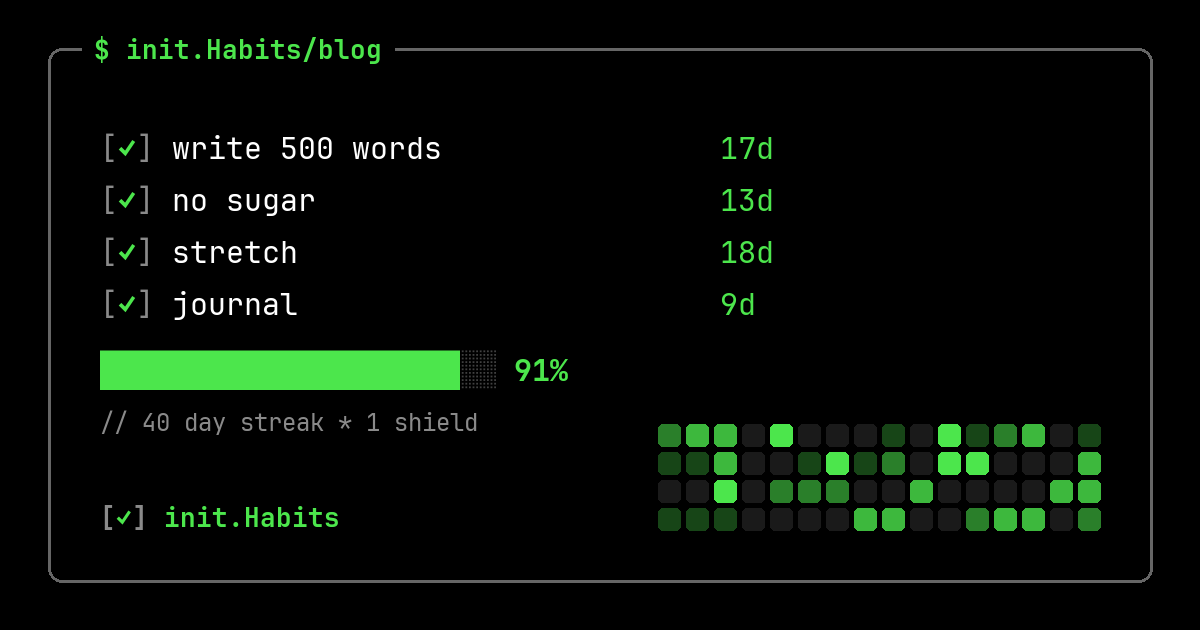
Most habit tracker ideas lists are padded to a round number and forgotten by the reader before the scroll ends. This one has a different job: give you a wide menu, organized by what part of your life the habit serves, with a note on why each one tracks well — because plenty of worthy habits make terrible tracker rows, and plenty of small ones punch far above their size. If you'd rather have a tighter, opinionated shortlist — including the habits that honestly aren't worth a row — that's what habits to track; how many to run at once is covered in finding your ceiling. This page is for browsing the full menu, and for matching each pick to the format that makes it stick.
Health and body
- A daily walk — the highest benefit-to-excuse ratio in the list; the WHO's activity guidance is reachable mostly through walking.
- Strength training — two to three sessions a week; track the showing-up, not the numbers.
- Water — a counter habit, not a checkbox; taps through the day beat one evening guess. The water tracking guide covers targets.
- In bed by a set time — the keystone most other habits secretly depend on; sleep runs the show.
- Stretching or mobility — five minutes counts; this one lives or dies by being tiny.
- A vegetable with every dinner — narrower and more trackable than "eat healthy".
- No alcohol today — abstinence habits track cleanly as a marked clean day.
- Sunlight before noon — oddly powerful for sleep timing, trivially cheap to log.
- Floss — the classic starter habit: 30 seconds, zero excuses, perfect for learning the tracking reflex itself.
Focus and work
- One deep work block — a timer habit; 25 or 50 minutes of one task, notifications off.
- Plan tomorrow before closing the laptop — two minutes that saves the morning's willpower.
- Inbox to zero once — once, deliberately, instead of forty ambient checks.
- No phone for the first hour — a boundary habit; the day starts on your terms.
- Ship something daily — for makers; the smallest publishable unit counts. Developers have a dedicated version of this one.
- Write 200 words — small enough to survive busy days, large enough to accumulate a draft.
Learning
- Read 10 pages — a quantity habit; pages are honest where "read more" is a mood.
- Flashcard review — ten minutes of spaced repetition; the streak matters more than session size.
- Language practice — daily contact beats weekend binges by a wide margin.
- One tutorial or chapter of a course — progress through material you already own, before buying more.
- Practice an instrument — a timer habit; fifteen focused minutes daily outplays a Sunday hour.
Money and home
- Log today's spending — thirty seconds of honesty; the logging changes the spending.
- A no-spend day — track the abstinence, watch the month change shape.
- Ten-minute tidy — one timer, one room; keeps the weekend from becoming a cleaning shift.
- Cook dinner at home — saves money and quietly upgrades the health column too.
- Inbox the paperwork — mail opened, bills filed, the adult-life admin that compounds when ignored.
Digital hygiene
- Screen time under a target — check the number each evening, mark the day green or not.
- No social media before lunch — a fence around the morning's attention.
- Phone out of the bedroom — a placement habit; the charger moves, the scrolling stops.
- One notification purge a week — prune what's allowed to interrupt you.
Quitting-shaped habits — the no-alcohol, no-doomscroll, under-the-limit rows — behave differently from building-shaped ones, and the breaking bad habits guide covers tracking the clean day instead of the slip.
Match each idea to a format
The quiet reason grids die in week two is format mismatch: a habit logged with the wrong mechanism becomes annoying to record, and annoying doesn't survive. Stuck for candidates? The habit ideas generator throws out concrete ones by category, so you're picking from a list instead of staring at a blank field.
| what you're tracking | format | example from the list |
|---|---|---|
| it happened or it didn't | checkbox | flossed, phone out of bedroom |
| repeats through the day | counter | glasses of water |
| a measurable amount | quantity | 10 pages, 200 words |
| time spent | timer | deep work block, instrument practice |
Ideas that look good and track badly
Some habits audition well and fail in the grid. "Be more present" can't be marked done, because done was never defined — vague intentions need converting into observable actions before they earn a row. "Lose weight" is an outcome, not an action; track the cooking and the walks that produce it instead. And a dozen new rows at once looks like commitment but performs like a demolition: every habit you add lowers the odds on all the others until the whole grid quietly folds. Three rows, sized for your worst day, is the boring setup that's still alive in six months.
FAQ
What are good habit tracker ideas for beginners?
Start with one tiny anchor (floss, or make the bed), one health habit (a daily walk), and one that serves a current goal (10 pages, or a deep work block). Three rows keeps the grid readable and the wins frequent. The point of the first month isn't the habits themselves — it's learning to keep a grid at all.
What should I put in my habit tracker?
Actions, not outcomes, and specific ones: "walk 20 minutes" rather than "be healthier", "read 10 pages" rather than "read more". Every row should be something you can look at in the evening and answer yes or no without negotiating with yourself. If a row needs interpretation, rewrite it until it doesn't.
What are examples of habits to track daily?
The reliable daily set: a walk, water intake, pages read, a deep work block, in-bed-by time, and a no-phone-first-hour boundary. Weekly-cadence habits like strength training or a no-spend day work too — just track them against their own schedule rather than expecting seven marks a week.
How many habit tracker ideas should I actually use at once?
Three to five, with three being the right answer for anyone starting out. Each addition taxes all the existing rows, and an abandoned ten-row grid teaches you the wrong lesson about yourself. Add a new row only after the current ones have felt automatic for a couple of weeks.