
Most habit trackers assume every habit is daily, and then quietly punish you for the ones that aren't. Gym three times a week, call your parents on Sundays, deep-clean the kitchen once a month, drop those into a daily tracker and every off day reads as a failure. A weekly habit tracker fixes that mismatch by letting each habit's schedule match the plan you actually have, instead of forcing everything into a daily mould.
It sounds like a small setting. It's the difference between a tracker that describes your life and one that argues with it.
Why a weekly habit tracker beats a daily-only one
A daily tracker wants seven checkmarks. If your real plan is three gym sessions a week, the app now calls your plan a failure four days out of seven. Nobody keeps trusting a tool that contradicts them that often, it's the same reason a streak that treats every day as mandatory eventually breaks. The habit was fine. The schedule the tracker imposed was the lie.
The schedules real habits actually have
Once you stop assuming "daily," the real patterns are obvious:
- X times per week, like the gym 3 times, with the days flexible.
- Specific days, like watering plants on Mondays or a weekly review on Sundays.
- Weekdays or weekends only, for habits tied to work or rest.
- A few times a month, for chores and maintenance that don't fit a weekly rhythm.
A tracker that can express these describes your week honestly. One that can't forces you to either skip them or feel like you're failing constantly.
Weekly goals beat daily guilt
A weekly goal, "3x per week," is forgiving by design. It lets rest days be rest days, lets you front-load the week or catch up later, and only asks whether you hit the number that mattered. That flexibility is what keeps non-daily habits alive, because it matches how those habits actually happen. Rigidity is the enemy of consistency here, not the friend it pretends to be.
How to set up a weekly habit
- Decide the real frequency, "3 times a week," not "every day," and be honest about it.
- Choose flexible (any 3 days) or fixed (Mon/Wed/Fri), depending on the habit.
- Set the bad-week minimum, even 1 of 3 keeps the habit alive on a rough week.
- Group weekly habits with your daily ones so the whole picture lives in one place.
- Judge it on the weekly target, not a daily streak, the number you set is the number that counts.
The bonus: less pressure, more consistency
There's a quiet psychological win here. A daily streak makes every single day feel load-bearing, which is exhausting. A weekly target spreads the pressure out, so one bad day doesn't threaten anything as long as the week still adds up. That breathing room is often what turns a habit you keep "for now" into one you keep for good. If you're still choosing which habits deserve a slot, the habits-worth-tracking list flags which ones are naturally weekly.
The one weekly habit worth adding even if you add nothing else is a fixed reset session — 40 minutes on the same day each week to clear the backlog the week accumulated. The Sunday reset routine has the block-by-block version.
Mixing daily and weekly habits
Most people's real routine is a blend: a few genuinely daily habits, a few weekly ones, and the occasional monthly chore. A good tracker holds all three in one view without forcing them into the same rhythm. The daily ones (vitamins, a short walk, journaling) keep a daily streak; the weekly ones (gym, a long review, calling family) track against their weekly target; the monthly ones just need to happen on time. Keeping them together matters, because a separate app for "weekly stuff" is an app you'll forget. One list, different schedules, is the setup that actually survives.
The catch-up trap
Weekly goals come with one failure mode worth naming: the Sunday-night scramble. If you leave all three gym sessions until the back half of the week, you'll either cram them unpleasantly or miss the target entirely. The flexibility is a feature, not a license to procrastinate. A simple guardrail helps, aim to be on pace by midweek, so a single bad day late in the week doesn't sink the whole goal. The point of a weekly target is to absorb one disruption, not to let you postpone everything to the edge. Used honestly, it gives you breathing room; used as an excuse, it just moves the cliff to Sunday. Set sensibly, weekly goals are one of the most underrated features in habit tracking, they're the difference between a system that fits a real, uneven week and one that only works in a fantasy where every day looks the same. Most people's routines need at least one or two of them.
FAQ
How do I track a habit I only do a few times a week?
Set a weekly goal, like "3 times a week," instead of a daily one, so rest days don't count as misses. A weekly habit tracker measures whether you hit the number, not whether you did it every day. init.Habits supports weekly goals and specific-day schedules for exactly this.
Should every habit be daily?
No. Plenty of worthwhile habits, gym, deep cleaning, calling family, are naturally weekly or occasional. Forcing them into a daily schedule just manufactures failure. Match the schedule to the habit's real rhythm.
Do weekly habits still have streaks?
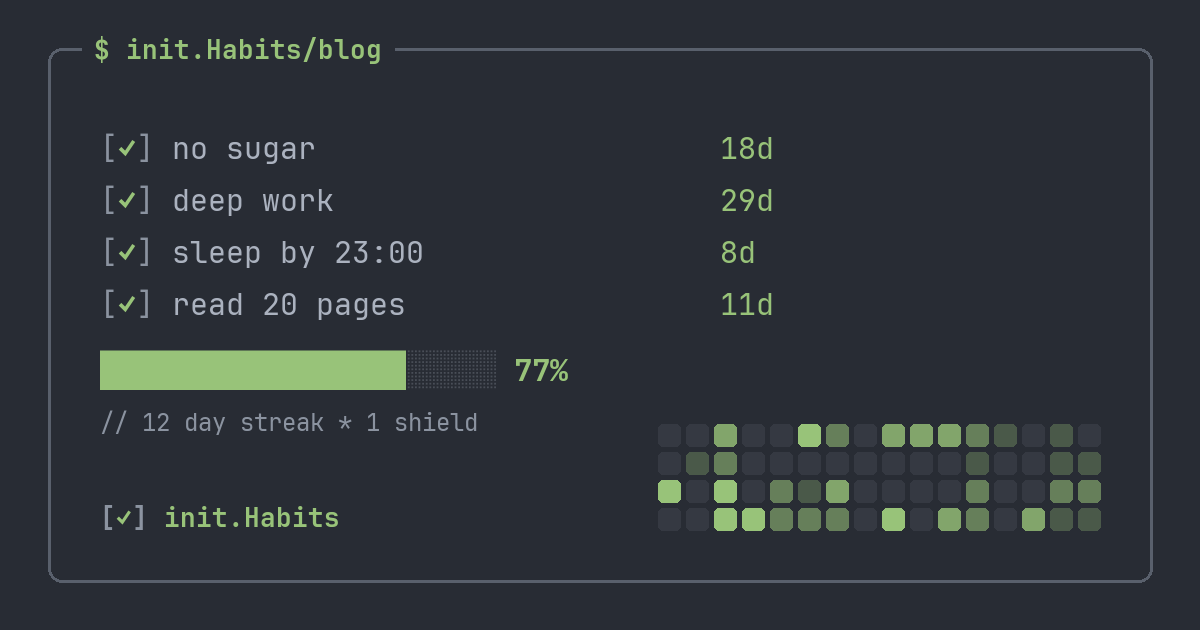
Yes. A weekly habit can keep a streak of weeks where you hit the target, which rewards consistency without demanding daily perfection. init.Habits keeps a streak and heatmap for weekly habits, counting the weeks you met the goal.
What's the benefit of weekly goals over daily ones?
Flexibility. Weekly goals let you shuffle which days you act, absorb a bad day without breaking anything, and stop the tracker from contradicting a plan that was never meant to be daily, which is what keeps the habit alive long-term.