
The advice to code every day is everywhere, and it's half right. Learning to code, or staying sharp as a working developer, really is a consistency game more than a talent one — the people who get good are mostly the people who kept showing up. But "code every day" gets taught as a green-squares challenge, where the goal quietly shifts from getting better to not breaking the streak, and that version burns people out or turns them into commit-fakers within a month.
So here's how to code every day in a way that actually compounds, without the cargo-cult grind. It comes down to three things: shrinking the daily minimum until it's nearly impossible to skip, protecting the habit from the days real life wins, and keeping the streak honest so it serves the skill instead of replacing it.
Make the minimum embarrassingly small
The number one reason daily coding habits die is that people define "a coding day" as a two-hour deep-work block. On the day you've got a full schedule, a headache, and zero energy, two hours is impossible, so you skip — and the skip becomes the crack the whole habit falls through.
Define the floor instead. Fifteen minutes. One small commit. One failing test made to pass. One function refactored. Something so small that on your worst day, skipping it feels sillier than doing it. The point of the tiny minimum isn't the fifteen minutes of output; it's that you stayed a person who codes daily, and tomorrow you pick up with nothing to rebuild. The big sessions still happen on good days — they just stop being the bar you have to clear to count.
This is also how skill actually accumulates. Frequent small touches beat rare marathons for anything you're trying to internalize, and the steady sense of forward motion is itself motivating — the progress principle found that small daily wins are the single biggest driver of engaged, productive work. Fifteen honest minutes a day, every day, will take you further than a six-hour binge every other week.
Separate "learning" days from "shipping" days
Not every coding day has to look the same, and pretending it does is another way the habit cracks. Some days you ship a feature. Some days you read code, do a kata, watch a talk and try the thing, or fix one tiny bug. All of it counts. If your definition of a valid coding day is narrow, you'll fail it constantly; if it's "I engaged with code deliberately for fifteen minutes," you'll keep it.
A tracker that supports different kinds of habits helps here. You might track "ship something" as a checkbox and "deliberate practice" as a timed pomodoro session, so a study night logs itself just as cleanly as a coding night. The habit is engaging with the craft daily, not performing one specific ritual.
Don't grind the green squares
The GitHub contribution graph is a genuinely useful feedback tool — you can read your consistency in one glance — but it has a dark side: it's easy to start optimizing for the grid instead of the skill. Whitespace commits, trivial README edits, and busywork pushed at 11:59pm to save a streak are all the habit eating itself. The graph is supposed to reflect that you coded, not become the reason you did.
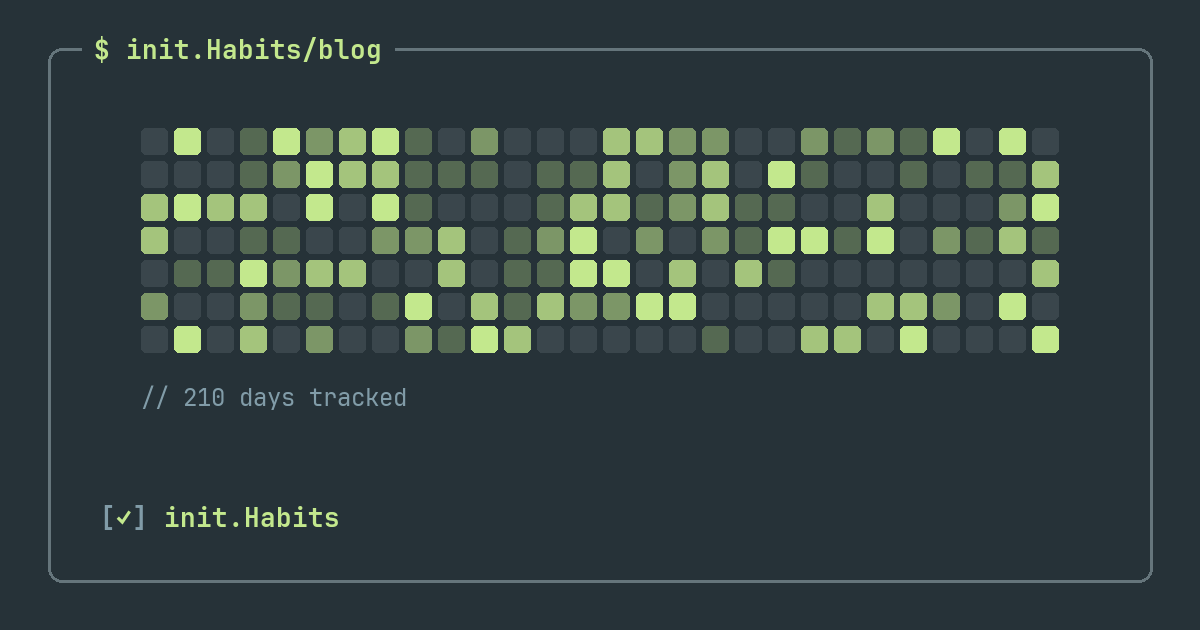
The fix is to track the habit you actually care about, separately from any public grid. A private habit tracker rendering your own GitHub-style heatmap gives you the satisfying visual without the temptation to game a public profile. And it reframes a missed day correctly: on a streak counter, one gap looks like a catastrophic 0; on a heatmap it's a lone empty cell in a wall of green, a far more honest read of a month's work. If a broken streak has ever made you quit entirely, why streaks break is the companion read.
Give the habit mercy for real life
You will miss days. On-call happens, crunch happens, you get sick, you take a holiday you actually deserve. A daily-coding habit with no plan for those days punishes you for being human and gets abandoned the first time life wins. So decide in advance: an unavoidable gap costs you a banked day, not the whole streak. Use earned streak protection for the weeks that genuinely fall apart, and treat a vacation as a vacation, not a failure. The developers who code daily for years aren't the ones who never miss; they're the ones who miss a day and are back at the keyboard the next, with nothing to prove and nothing to rebuild.
This is the practice version of the question; if you're shopping for the tool itself, what makes a good habit tracker for developers covers the feature checklist, and the terminal-habit-tracker guide covers the aesthetic.
FAQ
Should I really code every day?
Coding most days, with a tiny minimum, is one of the most reliable ways to improve, because skill compounds through frequent small repetitions. But "every day, no exceptions" is a trap — build in a bad-day minimum and accept the occasional miss, or you'll burn out or start faking commits to protect a streak.
How long should I code each day to build the habit?
Set the floor low — fifteen minutes or one small commit — not high. The goal of the minimum is consistency, not output: it keeps you a daily coder on bad days, while your good days still produce the long sessions. A small floor you always clear beats a big target you regularly miss.
Is there a habit tracker for a daily coding habit?
Yes. init.Habits renders your coding habit as a private GitHub-style heatmap with checkbox and timer tracking, earned streak freezes for the days real life wins, and 23 editor themes. It's a terminal-style habit tracker for iPhone, with a synced web app in any browser.
How do I keep a coding streak without gaming my GitHub graph?
Track the habit you actually care about in a private tracker, separate from your public profile, so there's no temptation to pad commits to save the grid. Count deliberate practice and learning, not just shipped code, and use earned streak protection so an unavoidable gap doesn't tempt you into a fake 11:59pm commit.