
Most gratitude habits die the same death. You read something about how it rewires your outlook, you buy a nice notebook, you write three heartfelt things for four days, and then one busy evening you skip it, and the notebook joins the pile. A gratitude habit tracker is the unglamorous fix for that specific failure: it keeps the practice alive on the ordinary days, when you don't feel inspired and "what am I grateful for" sounds like homework.
The research is genuinely encouraging here, but research only helps if the habit survives past the enthusiastic first week. That survival is a tracking problem, not a motivation problem.
Why gratitude is harder to keep than it sounds
Gratitude feels easy, which is the trap. There's no friction to push through, no gym to drive to, so people assume willpower will carry it. But the absence of friction is also the absence of a cue. Nothing in your day reliably says "now write your gratitude," so the practice floats free and gets crowded out by everything with a deadline.
A tracker gives it an anchor and a record. Once "gratitude" is a row you see each evening with a streak attached, it stops being a nice idea and becomes a small, specific thing you do. The point of a gratitude habit tracker isn't to grade your appreciation. It's to make the practice concrete enough that it actually happens on a Tuesday when nothing feels remarkable.
Shrink the practice until it's almost too small
The single biggest mistake is making the daily bar too high. "Write a full page about what you're thankful for" is a Sunday-morning fantasy, not a daily habit. Set the minimum at one thing. One genuine line, even a fragment, even "the coffee was good." A practice you can complete in fifteen seconds on your worst day is a practice that survives, and survival is the whole game with gratitude, because the benefit compounds from doing it often, not from doing it beautifully.
This is the same principle behind every habit that lasts: the habits worth tracking are the ones with a minimum small enough that you never dread them. On a good night you'll write more without being told to. On a bad night the one-line floor keeps the chain intact, and an intact chain is what gets you to the point where noticing good things becomes automatic.
What a gratitude habit tracker should track
For a gratitude habit, the thing you're tracking is the showing up, not the eloquence. A simple checkbox, "did I note something today," is the right tracking mode; the actual words can live wherever you like. That keeps the daily action genuinely fifteen seconds and stops the habit from collapsing under the pressure to produce a polished entry.
If you want the writing itself to grow into something bigger, that's a journaling habit, and it's worth building deliberately rather than expecting your gratitude line to quietly become a journal. Here we're keeping it narrow on purpose: one practice, one checkbox, one streak. Narrow is what keeps it alive.
Anchor it to a moment that already exists
Gratitude needs to ride on a cue, because it has none of its own. The two reliable anchors are the bookends of the day: the first coffee in the morning, or the moment you get into bed at night. Pick one and tie the practice to it, so noting something good becomes part of a sequence you already run rather than a separate thing you have to remember. That technique has a name — habit stacking — and it lives or dies on whether the anchor you picked really does happen every single day.
Evening tends to win for most people. The day's done, you can look back on it, and it pairs naturally with the rest of a wind-down. If your evenings are chaotic, do it in the morning about yesterday. The exact time matters far less than the fact that it's the same time, attached to the same trigger, every day. Consistency of cue is what turns a deliberate act into an automatic one.
Let the streak do the remembering
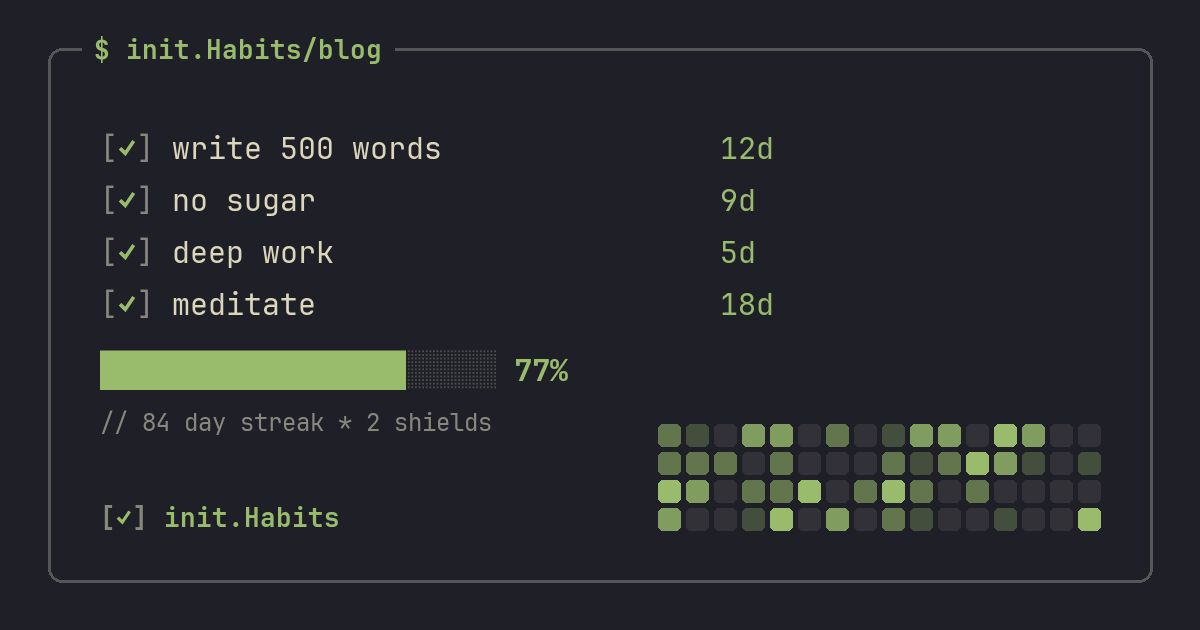
The honest motivation problem with gratitude is that any single entry feels pointless. One line about being thankful for the weather does nothing perceptible. The payoff is cumulative, which is exactly why a visible record matters so much: it shows you the volume you'd otherwise never feel. A heatmap of a grateful month, or a streak counting steadily up, turns dozens of forgettable little entries into one undeniable picture of a habit you're actually keeping.
And because life interrupts everything, the practice needs to forgive a missed night. A streak freeze covers the evening you fall asleep before you remember, so one lapse doesn't wipe a month and tempt you to quit. Decades of research on gratitude point to real benefits for mood and wellbeing, but every one of those findings assumes the habit lasts long enough to matter. A forgiving tracker is how you get there.
FAQ
How do I start a gratitude habit?
Set the daily bar absurdly low, one genuine thing you're grateful for, and anchor it to a cue you already have, like your morning coffee or getting into bed. Track it as a simple checkbox so showing up is what counts, not how much you write. A tiny, anchored, tracked practice is far more likely to survive than an ambitious one.
Should I write gratitude in the morning or at night?
Either works; pick the one with a reliable cue and stick to it. Evening suits most people because you can reflect on the day just gone and it fits a wind-down routine. The consistency of doing it at the same anchored moment matters more than which end of the day you choose.
How is a gratitude habit different from journaling?
Gratitude is a narrow daily practice, often a single line, tracked as a checkbox. Journaling is broader, longer-form writing that benefits from its own setup and a deliberate minimum. Keeping gratitude narrow is what makes it sustainable; if you want the writing to grow, build a journaling habit separately rather than expecting one to become the other.
What if I miss a day of my gratitude practice?
Don't treat one miss as failure. Use a streak freeze to keep the chain intact, then simply do it again the next day. The benefit of gratitude comes from doing it often over months, not from a flawless record, so the goal is to keep the habit alive, not to never miss.