
There's an obvious tension in using a meditation habit tracker. Meditation is supposed to be the one thing in your day that isn't about output, streaks, or hitting a number — and here you are, about to turn it into a number with a streak. Plenty of people feel that friction and decide tracking will poison the practice, so they don't, and then the daily sit quietly disappears the way untracked habits do.
I think that's the wrong conclusion from a real concern. A meditation habit tracker can absolutely ruin the practice, but only if you track it badly. Tracked well, it does the one thing meditation most needs, which is to keep showing up on the days you'd otherwise talk yourself out of it. The trick is choosing what to measure, and what to deliberately not.
Track that you sat, not how well it went
The first rule is the most important: track presence, not quality. There's no useful metric for a "good" meditation. Some sessions are calm, most are a tug-of-war with your own attention, and the restless ones often count for just as much. If your tracker nudges you to rate the session or chase a "deep focus" score, you've imported the exact achievement mindset the practice is meant to loosen.
So the honest unit is binary or duration: did you sit, and for how long. A checkbox for "meditated today" is enough for a lot of people. If you want a little more, track minutes — but as a floor you cleared, not a high score to beat. Ten minutes that happened beats twenty you keep meaning to do.
Duration mode beats a plain checkbox here
This is one habit where a timer genuinely helps. A checkbox says yes or no; a timer both runs the session and logs it in one motion, so you're not fishing for your phone afterward to mark it done. Start the timer, close your eyes, and the completion records itself when the bell rings. It's the same logic that makes a built-in pomodoro good for focus work: the tool that measures the thing should also be the tool that logs it, so logging never becomes a separate chore you can forget.
A timer also lets you set an honest target — say ten minutes — and still get credit for a short sit on a hard day, because what you're really tracking is the floor, not perfection. Which brings up the part most people get wrong.
Build in a bad-day minimum
The fastest way to kill a meditation habit is to define it as "twenty minutes, seated, undisturbed." On the day you wake up late with a packed calendar, twenty undisturbed minutes is impossible, so you skip, and one skip becomes the crack the whole habit falls through.
Define the minimum now, while it's easy. One minute. Three breaths in the parking lot. A single conscious pause before the first meeting. On a good day you do the full sit; on a wrecked day you do the minimum and still log it, and the chain holds. This matters more than it sounds, because habits are built by repetition over months, not by heroic individual sessions, and a practice that can't survive a bad day won't be around long enough to compound. A minimum you'll actually keep is worth more than an ideal you abandon.
The streak is a feature, not a threat
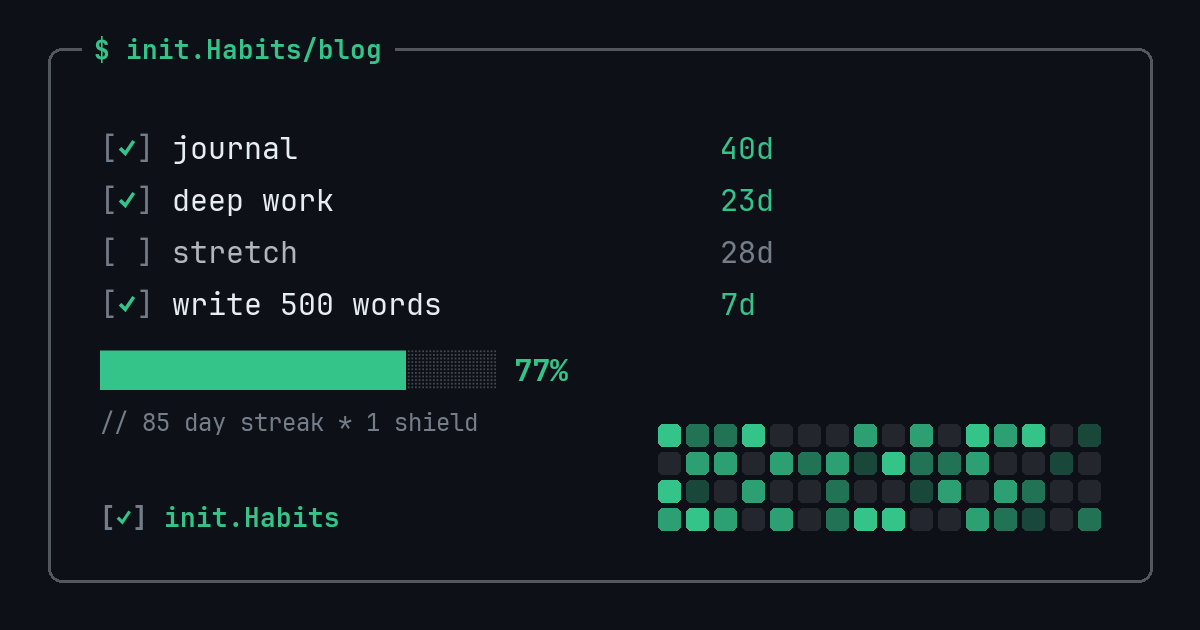
People worry that a streak turns a peaceful practice into a pressure machine. It can, if the app treats one missed day as a catastrophe. The fix isn't to abandon the streak — momentum is genuinely motivating, and seeing thirty unbroken days of sitting is a quiet kind of proof. The fix is a tracker that lets a missed day be a missed day. Earned streak protection means an unavoidable gap costs you a banked day instead of erasing a month, and on a heatmap a single skipped sit is a quiet gap in a long run of color, not a flashing zero. If you've ever quit something the day after breaking a streak, why streaks keep breaking is worth a read.
Where it fits in a routine
Meditation rarely thrives as a free-floating intention; it thrives anchored to something you already do. After you start the coffee, before you open your laptop, right after you brush your teeth — pick an existing cue and let it trigger the sit. That's why meditation so often lives inside a morning routine or an evening wind-down: the surrounding routine carries it. Track it as one habit in that sequence rather than an isolated goal, and it stops depending on you remembering and starts depending on the routine, which is far more reliable. If you're still deciding what your daily set should look like, what habits to track covers how to keep the list small enough to actually keep.
FAQ
Should I track my meditation habit at all?
If consistency is your goal, yes — a visible streak and a daily nudge keep the practice in front of you on the days you'd drift. The key is tracking only that you sat (and maybe for how long), not rating the quality of the session, so the tracker supports the practice instead of competing with it.
Is there a meditation habit tracker with a timer?
Yes. init.Habits tracks meditation with a built-in timer that runs the session and logs it automatically, plus earned streak freezes for the days you can't sit. It's a calm, monospace habit tracker for iPhone, with a synced web app in any browser.
What should I track — minutes or just whether I meditated?
Either works; pick the lighter one you'll keep. A simple "meditated today" checkbox is plenty for many people. Tracking minutes adds a little detail and pairs well with a timer, as long as you treat the number as a floor you cleared, not a high score to chase.
How do I keep a meditation streak without stressing about it?
Set a tiny bad-day minimum — one minute or three breaths — so even a chaotic day keeps the chain intact, and use a tracker with earned streak protection so a genuinely missed day costs a banked freeze instead of resetting everything. The streak should be encouragement, not a threat.