
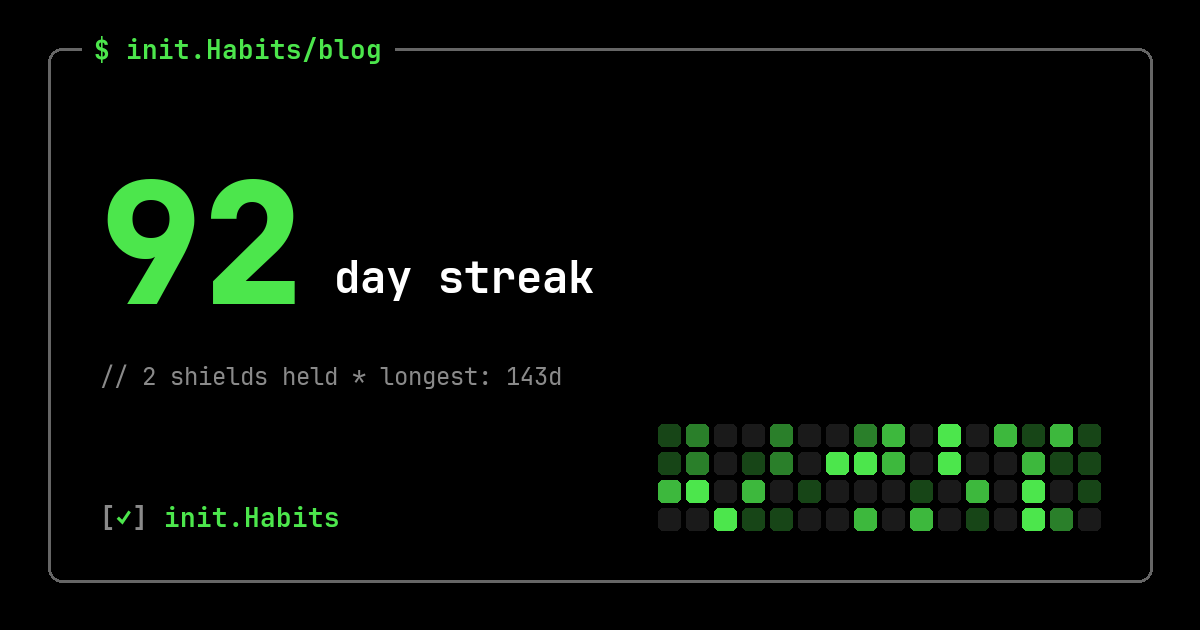
A streak tracker app does one narrow thing: it counts the consecutive days you've done something, and shows you the number. That sounds too simple to get wrong, which is why almost every habit app ships a streak. But live with one for a few months and you learn that the counter isn't the interesting part. The reset rules are. What happens on the day you miss decides whether a streak tracker app keeps you going for a year or teaches you to quit by week six — and different apps answer that question in very different ways.
Why a chain of days works at all
The mechanic is old. Jerry Seinfeld's version was a wall calendar and a red marker: write jokes, cross off the day, and after a while your only job is don't break the chain. The number works because it slowly turns into evidence. At day 3 a streak is trivia. At day 40 it's a small fact about who you are, and skipping starts to feel like contradicting yourself. That is accountability with nobody else in the room, and it's the only version that doesn't need a partner to keep replying. That pull is genuinely useful — and the same pull, pointed the wrong way, is what makes a badly designed streak dangerous.
Not all streak math is the same
Under the hood, streak trackers run one of four models. Hard reset: any missed day sends the count to zero, no exceptions. Unlimited or purchasable freezes: misses can always be papered over, often for money. Earned freezes: consistent days bank a limited cover for future misses. Weekly targets: the streak counts weeks in which you hit, say, five of seven days, so individual misses dissolve into the week. Apps rarely advertise which model they use. It's worth finding out before you invest three months in a number.
Streak reset models compared
| model | one missed day | what the number ends up meaning |
|---|---|---|
| hard reset | back to zero | perfection — until it breaks you |
| unlimited / paid freezes | nothing, ever | not much; the count inflates |
| earned freezes | costs a banked cover | consistency, with honest slack |
| weekly target | absorbed if the week still hits | showing up most days |
The two extremes fail in mirrored ways. A hard reset makes the number mean everything, so one bad day destroys months of evidence. Unlimited freezes make it mean nothing, because a count that can't fall isn't a record. The middle rows keep the number honest while leaving room for a life.
The hard-reset trap
Psychologists have a name for what a zeroed counter triggers: the abstinence violation effect — one lapse gets read as total failure, and the response to failing totally is to stop entirely. A 60-day streak erased by one long-haul flight doesn't motivate anyone to start day one again; more often it ends the habit, because the thing that was carrying it just publicly died. If your streaks keep snapping for reasons you can't name, why you keep breaking your streak digs into the psychology. This post's concern is narrower: pick an app whose math doesn't amplify the effect.
What else the app needs around the counter
A good streak tracker app keeps a separate streak per habit, because your reading and your running will not fail on the same days, and one global number just reports whichever habit is weakest. You want history you can see — a year of marks, not just today's count — so a slump reads as a dent in a long record instead of a fresh zero. You want a reminder tied to each habit's own time. And the current number belongs somewhere you'll pass it without opening anything, which is what a home-screen widget is for. None of this is exotic. It's just rarely all in one place.
Start the streak smaller than feels impressive
One more thing the app can't do for you: pick a habit small enough to streak. A chain of "ran 10k" days will be short. A chain of "put on running shoes and got out the door" days can run for months, and the long chain changes behaviour more than the heroic short one ever did. Day one is the only day motivation is guaranteed to attend, so spend it choosing the size, and if the streak does break anyway, getting back on track is a skill you can learn separately. The details of how earned shields accrue and get spent live in the streak freeze guide.
FAQ
What is a streak tracker app?
An app that counts the consecutive days you've completed a habit and displays the running total, so the growing chain itself becomes the motivation. init.Habits is one built around honest streak math: per-habit streaks, a year-long heatmap of your history, and earned streak freezes that cover a genuine miss without inflating the count.
Should a missed day reset my streak to zero?
Ideally no — not automatically. A hard reset turns one bad day into the loss of months of evidence, which is exactly the moment people abandon the habit altogether. Look for earned freezes or weekly targets: both keep the number meaningful while making a single miss survivable. What you want to avoid is the other extreme, where misses never cost anything.
Are streak freezes cheating?
Unlimited ones are — a streak that can't end isn't a streak. Earned ones aren't, because the cover itself is produced by consistency: you get protection only by showing up repeatedly first. Think of it as the difference between insurance you've paid premiums on and a number that simply refuses to go down.
What's a good streak length to aim for?
Don't aim at the number; aim at the habit surviving bad weeks. That said, the first meaningful milestone is around 30 days — long enough that the record starts feeling like identity — and research puts actual automaticity anywhere from two months up. The count is the byproduct. Showing up at a size you can sustain is the actual work.