
You were doing so well. A 30-day streak, then a trip, then a bad week, and suddenly it's been a month since you logged anything. Working out how to get back on track after breaking a habit somehow feels harder than starting did the first time, because now there's a layer of guilt sitting on top of the habit.
Here's the reassuring part: the comeback is almost entirely a mindset problem, and a small one. The mechanics are easy once you stop treating the gap as a verdict.
The slip didn't undo your progress
The reason a lapse feels catastrophic has a name. The abstinence violation effect describes the moment after a slip when your brain reclassifies the whole project as failed, so you stop protecting it. But that's a story, not a fact. In the most-cited study on habit formation, missing days didn't erase the automaticity people had already built, the groove you carved over weeks is still there. A month off doesn't reset you to zero; it just means you haven't used the habit lately. (If your streaks snap more often than they should in the first place, that's a separate, fixable problem, covered in why you keep breaking your streak; this post is about the comeback after it's already happened.)
Don't start over, just start
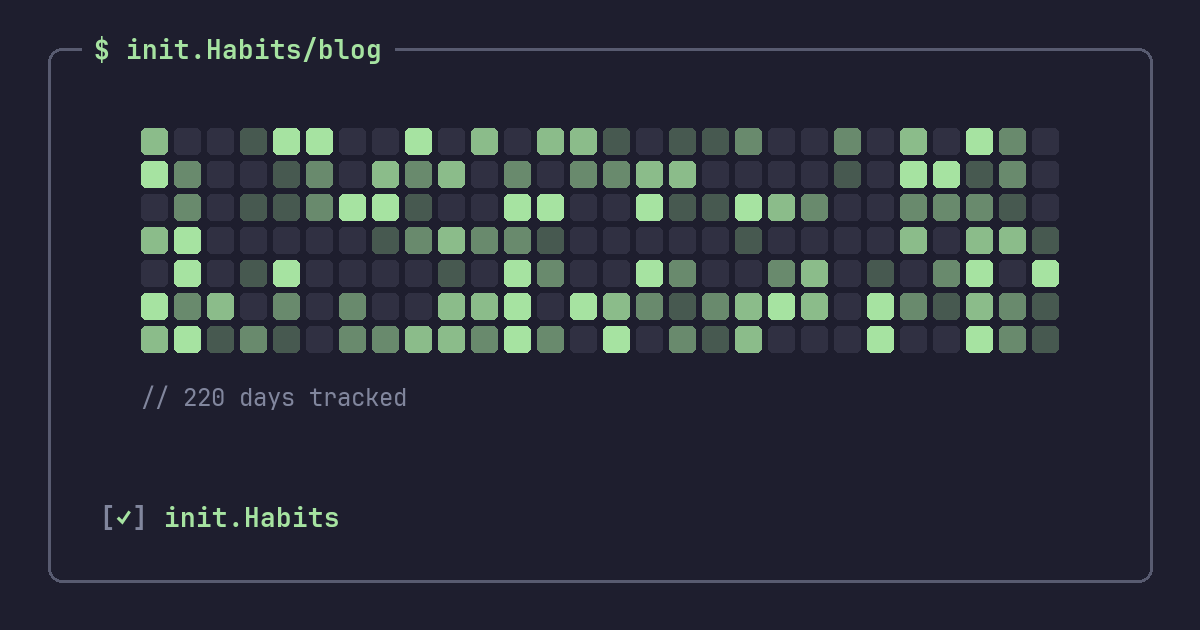
The single most useful reframe: you're not restarting, you're resuming. "Starting over from day one" is a punishment your tracker invented, not a real description of your progress. Open the app and log today. That's it. On a heatmap, the gap reads as exactly what it is, a pale patch in a field of green, and every day you add afterward visibly shrinks it. The graph is biased toward getting back on, which is the single most useful bias a tracker can have.
Shrink it back down
Come back smaller than you left. If you were running 5k, the comeback workout is a 10-minute jog. If you were reading 30 pages, it's 5. The goal of the first week back isn't performance, it's proving to yourself that the habit still exists. Rebuild the volume later; right now you're just re-establishing the chain, and a tiny link counts as much as a big one for that purpose.
How to get back on track, step by step
- Log today. Don't re-litigate the gap or wait for Monday, just record the current day.
- Pick the smallest version of the habit and do that, not the ambitious one you left.
- Forgive the gap explicitly. It cost you some days, not the habit.
- Put the checkbox back where you'll see it, a home-screen widget, so logging is frictionless again.
- Set up a buffer for next time (see below) so the next bad week doesn't become another month.
Build in a plan for next time
A comeback is also a chance to fix the system that let the streak collapse. Most lapses turn into long gaps for one of two reasons: the habit was too big for bad days, or there was no protection for them. So size the habit for your worst day, and use a tracker with earned streak freezes so an occasional miss spends a resource instead of breaking everything. The difference between a one-day slip and a one-month disappearance is almost always what happened in your head right after the miss. Build the system so the next slip stays a slip.
Why the comeback feels harder than the start
Restarting a lapsed habit feels heavier than starting fresh, and it's worth understanding why, because the weight is almost entirely imaginary. The first time, you had a clean slate and a story about becoming a new kind of person. The comeback carries a different story: that you already tried and failed, so why expect this time to be different. That narrative is the actual obstacle, not the habit, which is just as easy to do as it ever was. The fix is to refuse the story. You didn't fail; you paused. People pause all the time and resume, and the ones who keep habits for years are simply the ones who got good at resuming quickly and without drama. Treat the comeback as a non-event, log today, move on, and the heaviness has nothing to hold onto.
Make resuming the default, not the exception
The deeper win is to expect lapses and design for them in advance, so getting back on track stops being a special occasion. Real life guarantees disruptions, a trip, an illness, a deadline, so a system that only works during smooth stretches isn't really a system. Bake in the recovery: a tiny minimum that's possible on any day, earned streak freezes for the genuine misses, and a flat rule that you log the current day no matter how long the gap was. When resuming is the built-in default rather than a heroic effort, a missed week stays a missed week instead of becoming the end of the habit. And once you're back, the work shifts from recovering to staying consistent in the first place, which is how you end up needing this page less often.
FAQ
Do I have to start my streak over after missing days?
Only if your tracker forces it, and even then the reset is just arithmetic. Your actual progress, the automaticity you built, doesn't reset with the number. It's worth using a tracker with streak freezes so an occasional miss costs a resource instead of the whole streak.
How do I get motivated to restart a habit I quit?
Stop waiting for motivation and shrink the task until starting is trivial, one page, one set, two minutes. Log it the same day. Momentum returns from doing, not from feeling ready, and the visible streak rebuilding gives you the motivation you were waiting for.
Why do I keep falling off my habits?
Usually because the habit was sized for good days and had no plan for bad ones. The fix is a smaller minimum, a schedule that matches your real life, and streak protection for the inevitable off days. init.Habits' shields exist for precisely this pattern.
How long does it take to rebuild a broken habit?
Often faster than building it the first time, since the groove is still partly there. Focus on consecutive small wins rather than a target date, and let the heatmap show the gap closing.