
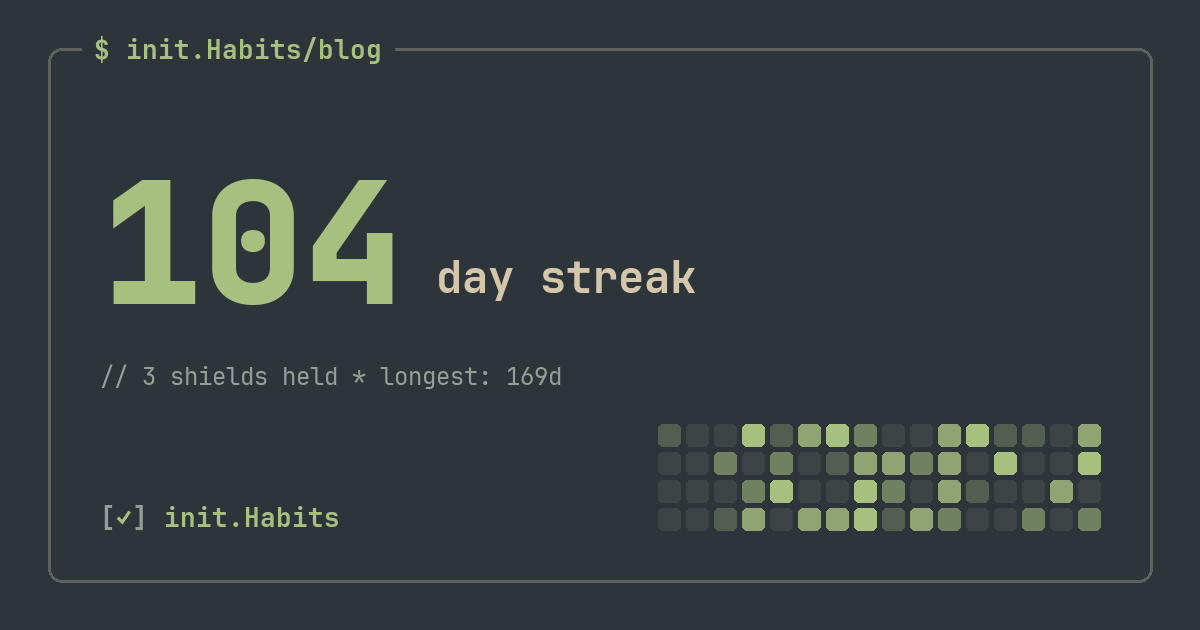
Using a habit tracker for breaking bad habits feels backwards at first. Trackers are built to log the things you did — workouts, pages read, water drunk — and breaking a habit is about the thing you didn't do. But that's exactly the reframe that makes it work: instead of tracking the bad habit, you track the clean day. Every day you don't smoke, don't doomscroll past midnight, don't bite your nails, you log a win. The absence becomes a presence you can tick, and a streak you can watch grow.
That small shift — from counting failures to counting clean days — is most of the battle. It turns quitting from a vague test of willpower into the same visible, streak-driven game that builds any other habit.
Track the streak of clean days
The mechanic is simple: each day you avoid the habit, you mark it done. One clean day, then two, then a chain you don't want to break. A day counter or a contribution heatmap turns "I'm trying to quit" into a concrete, growing number, and that number becomes something worth protecting. The same "don't break the chain" instinct that drives a writing streak works just as well pointed at a habit you're trying to lose.
The visible streak matters more here than almost anywhere, because quitting has long stretches with no obvious reward. You don't feel the benefit of not scrolling at 1am the next morning, not directly. A streak gives the clean days an immediate, tangible payoff — the count goes up — which bridges the gap until the real benefits arrive.
Replace, don't just remove
Pure subtraction is hard. A habit you just delete leaves a hole at the exact moment and mood that used to trigger it, and the urge rushes into the gap. The behaviour that lasts swaps the bad habit for a small replacement at the same cue: when the after-dinner cigarette urge hits, you take a two-minute walk; when your hand reaches for the phone in bed, you pick up a book instead. So track two things — a clean day from the old habit, and a tick for the replacement. The replacement is what makes the clean day sustainable, and tracking it gives the cue something new to point at.
This is also a more honest picture of what you're doing. You're not just removing; you're building a different response to an old trigger, and the new response deserves its own streak. If you're still deciding which habit to point this at, these examples of bad habits list the common ones alongside the smaller behaviour that tends to fit the same cue.
Getting the swap right depends on naming the reward correctly, and most people get that part wrong — the reward is usually the pause or the novelty rather than the thing itself. Habit loop examples pulls five real habits apart into cue, routine and reward so you can see which part to change.
Plan for the slip, because there will be one
Here's the part that decides whether you actually quit: what happens after a slip. Almost everyone trying to break a habit will slip at least once. The danger isn't the slip itself — it's the spiral after it, where one cigarette or one late-night binge gets read as "I've failed, might as well give up." Psychologists call that the abstinence violation effect, and it does far more damage than the original lapse. A single slip is a data point; a spiral is a relapse.
A tracker helps here precisely because it makes the slip small and visible. On a heatmap, one lapse is a single off day in a long run of clean ones — obviously a blip, not a collapse. With earned streak protection, an honest slip can cost a banked day instead of zeroing everything, so the chain survives and you keep going. The whole skill of breaking a habit is really the skill of getting back on track fast after a slip, and a tracker that doesn't punish you for one is built for exactly that.
Why streaks beat willpower for quitting
Willpower is a finite tank that empties over a day, which is why bad habits win most often at night when you're depleted, and why building self-discipline is far more about your environment than your grit. A streak works differently: it shifts the motivation from "resist the urge" to "protect the chain," and protecting something you've built is easier than resisting something you want. Each clean day makes the next one cost a little less, because now there's more to lose. That's the same compounding that makes building a good habit easier over time — it just works in reverse, in your favour, against the habit you're trying to drop. If broken streaks have ended your attempts before, why streaks break and how to stop it is worth reading alongside this.
FAQ
Can you use a habit tracker to break a bad habit?
Yes, and it's one of the most effective ways to do it. Instead of tracking the bad habit, you track each clean day as a completed habit, building a streak of days you avoided it. That turns quitting from a vague willpower test into a concrete, visible chain you're motivated to protect.
Should I track the bad habit or the good replacement?
Track both. Mark a clean day each time you avoid the old habit, and track the small replacement behaviour — a walk, a book, a glass of water — that you do at the same trigger instead. The replacement is what makes the clean day sustainable, and giving it its own streak reinforces the new response.
What happens to my streak if I slip up?
A slip doesn't have to end everything. The real risk after a lapse is giving up entirely, so a tracker with earned streak protection lets an honest slip cost a banked day rather than zeroing the whole count. On a heatmap, one off day in a long clean run reads as a blip, which is exactly what it is.
How long does it take to break a bad habit?
Longer than the popular "21 days," and it varies by person and habit — plan for a couple of months of consistent clean days. That's why the streak and the slip-recovery plan matter so much: the habit has to survive lapses along the way rather than resetting at the first one.