
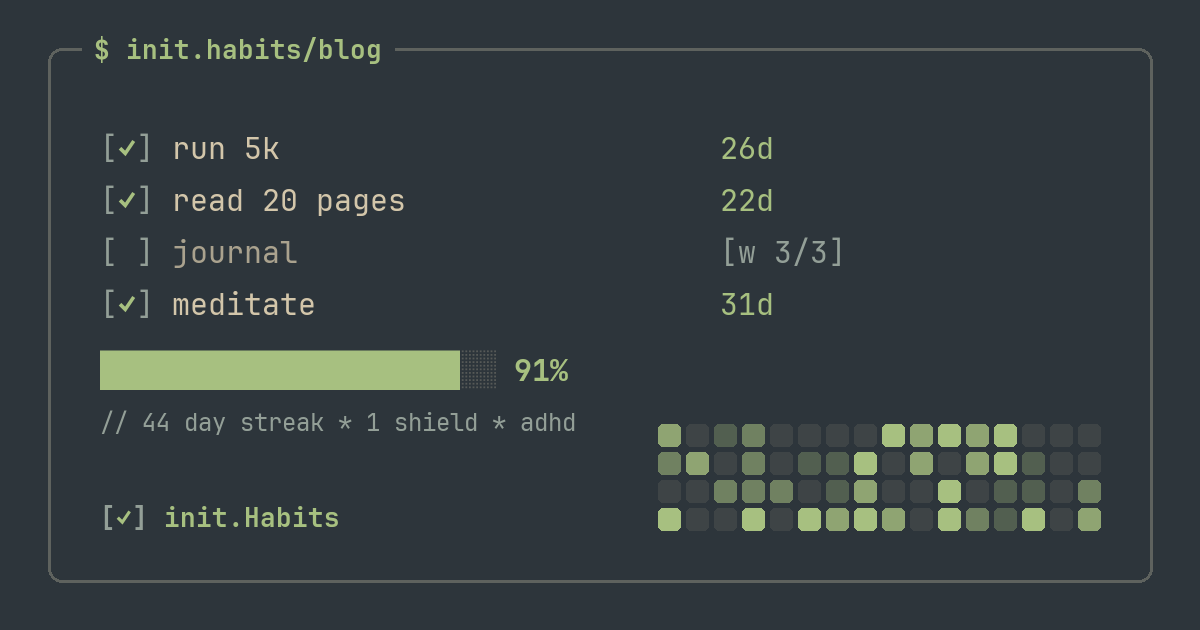
If you have ADHD, you've probably started more habit trackers than you can count. The first few days go great. Then one busy afternoon you forget, the streak snaps back to zero, and the app quietly becomes another thing you're avoiding. A habit tracker for ADHD has to account for that exact moment, because for an ADHD brain a missed day isn't a rare slip. It's Tuesday.
The problem usually isn't you, and it isn't a shortage of willpower. Most trackers are built for brains that already have steady follow-through. Yours runs on different fuel, and an app that ignores that will lose to your wiring every single time.
It's executive function, not motivation
ADHD mostly affects the brain's executive-function system: working memory, sense of time, and the ability to start something boring on demand. The National Institute of Mental Health describes it as an ongoing pattern of inattention and impulsivity that gets in the way of daily functioning. Remembering to "just do the habit" isn't a character test. The reminder itself has to compete with everything else for a resource that's already stretched thin.
Two things follow from that, and they shape everything about what works:
- You'll forget, sometimes for days, not because you don't care but because the cue never actually landed.
- Rewards have to be immediate. A payoff three weeks out barely registers. A payoff in three seconds does.
Build around those two facts and tracking gets easier. Fight them and you're back to a graveyard of abandoned apps by March.
Why most habit trackers fail ADHD brains
Pull up a typical tracker and count the friction. You open it, scroll to find the habit, tap into a detail screen, set a value, confirm, close. That's five steps to record one thing, and for an ADHD brain five steps is four too many. The habit you're tracking was never the hard part. Logging it was.
Then there's the all-or-nothing streak. Miss one day and the number resets to zero, which sounds harmless until you feel it. Psychologists call the spiral that follows the abstinence violation effect: one slip reframes the whole project as failed, so you quit the thing entirely. I wrote about that trap in more depth in why you keep breaking your streak, and it hits ADHD brains harder because the shame lands faster and louder.
The other two failures are quieter. The reward is invisible, buried in a stats screen you never open, so the dopamine never arrives. And the interface is loud: badges, bright pop-ups, notifications stacked three deep, every one of them a small tax on attention you can't spare.
What to look for in a habit tracker for ADHD
You don't need more discipline. You need an app that does the remembering and the rewarding for you. Five things matter, roughly in this order:
- Two-second logging. One tap from the home screen, no detail screen, no friction. If recording a habit takes longer than doing the smallest version of it, the app is working against you.
- Forgiveness that's built in. Look for streak freezes (init.Habits calls them shields) that absorb a missed day so the number survives. This isn't a gimmick. It removes the single most common reason ADHD users rage-quit a tracker.
- Feedback you can feel. A GitHub-style heatmap, levels, XP, a streak that climbs. Gamification gets a bad rap, but for a brain that's short on dopamine it's the point. The reward has to be visible the instant you log, not three weeks later.
- A calm, consistent look. A cluttered, high-contrast UI is its own distraction. Pick something quiet and familiar. init.Habits ships 23 editor themes, so the tracker can fade into the background instead of shouting.
- It lives where you already look. A home-screen or lock-screen widget turns the cue from "remember to open the app" into "see it, tap it." For ADHD, that one change does more than any notification.
A few apps market themselves to ADHD directly, and they're worth knowing before you pick. Grit is a colourful Apple-ecosystem planner with an Apple Watch app; RoutineFlow walks you through a routine as a chain of per-step timers, aimed squarely at the "can't get started" problem. Both are compared to init.Habits honestly, so you can see which trade-offs fit your brain. And if what you're actually trying to track is coursework, study habits for ADHD adapts the standard study advice for the same wiring.
Here's what the two-second version actually looks like in practice:
$ meds      [✓]
$ walk      [✓]
// two taps, streak intact
No menus, no decision. That's the bar.
A setup that works with an ADHD brain
Picking the right app is half of it. How you set it up is the other half, and this is where most people overload day one and burn out by day four.
- Start with one or two habits, not ten. Motivation is high when you set up a new app, which is exactly why you over-commit. Pick the smallest meaningful thing and add more only once it's automatic. If you're stuck on what, this guide on what to track is a good place to start.
- Anchor each habit to something you already do. "After I pour my morning coffee, I take my meds." The existing routine becomes the cue, so your working memory doesn't have to hold it.
- Define the minimum version. "Walk" becomes "put my shoes on and step outside." On a bad day you still log it, the streak holds, and momentum survives. Lowering the bar isn't cheating. It's how the habit gets past your brain's resistance to starting.
- Use a freeze the first time you miss, on purpose. Don't wait for an emergency. Spend one early so you learn the streak can take a hit and keep going. That single experience rewires how you react to the next real miss.
And when you do miss, remember it matters far less than it feels. In a University College London study on how habits form, people who skipped a single day showed no measurable dip in how automatic the behaviour became. One missed day doesn't undo weeks of work. The only thing that does is quitting because of it.
FAQ
Is there a habit tracker made for ADHD?
No mainstream app is marketed strictly for ADHD, but the features that help are specific: instant one-tap logging, streak freezes so a missed day doesn't reset everything, a visible heatmap and XP for immediate feedback, and home-screen widgets. init.Habits was built around exactly that combination, which is why it tends to fit ADHD users well even though it isn't badged as an ADHD product.
How many habits should someone with ADHD start with?
One or two. The urge to track everything is strongest on day one and fades fast. Get a single habit to feel automatic before you add the next, otherwise you're managing the tracker instead of the habit.
Do streaks help or hurt ADHD?
Both, depending on the app. A streak you can see climbing is great dopamine. A streak that wipes to zero on one slip is a shame trigger. The fix is forgiveness: a tracker with streak freezes keeps the reward without the punishment, which is the combination that actually sticks.
What if I forget for a whole week?
Open the app and log today. Don't re-litigate the gap, don't start over from scratch, just record the current day and let the streak rebuild. A missed week is a data point, not a verdict, and the only failure mode that counts is deciding the whole thing is ruined.